
3.6. C Code Generation
In the previous Vala compiler steps, we verified that the validity of the Vala code. Now the compiler is ready to generate C code from the Vala source code.
In the Vala.Compiler.run () (compiler/valacompiler.vala) method, the compiler will eventually call Vala.CodeContext.codegen.emit () (vala/valacodecontext.vala) which starts the C code generation process.
3.6.1 How The Code Generation Works
3.6.1.1 Deciding which Vala.CodeGenerator instance type to use
Vala.CodeContext.codegen is a property for an instance of Vala.CodeGenerator (vala/valacodegenerator.vala). The object type is different based on the compiler profile that the user set:
- GObject profile:
GDBusServerModule(codegen/valagdbusservermodule.vala). - Otherwise:
CCodeDelegateModule(codegen/valaccodedelegatemodule.vala)
3.6.1.2 Modules Pattern with C Code Generator
Vala.CodeGenerator is an abstract class that is a code visitor for generating code. This is the base class for code generators in the compiler, it contains abstract methods to be overriden by subclasses that help wit hthe code generation process too.
The actual code generation logic is contained in its subclasses. The direct subclass of Vala.CodeGenerator is Vala.CCodeBaseModule (codegen/valaccodebasemodule.vala). Which actually overrides the Vala.CodeVisitor methods.
Vala.CCodeBaseModule contains the logic that provides the base functionality for generating C code from Vala code.
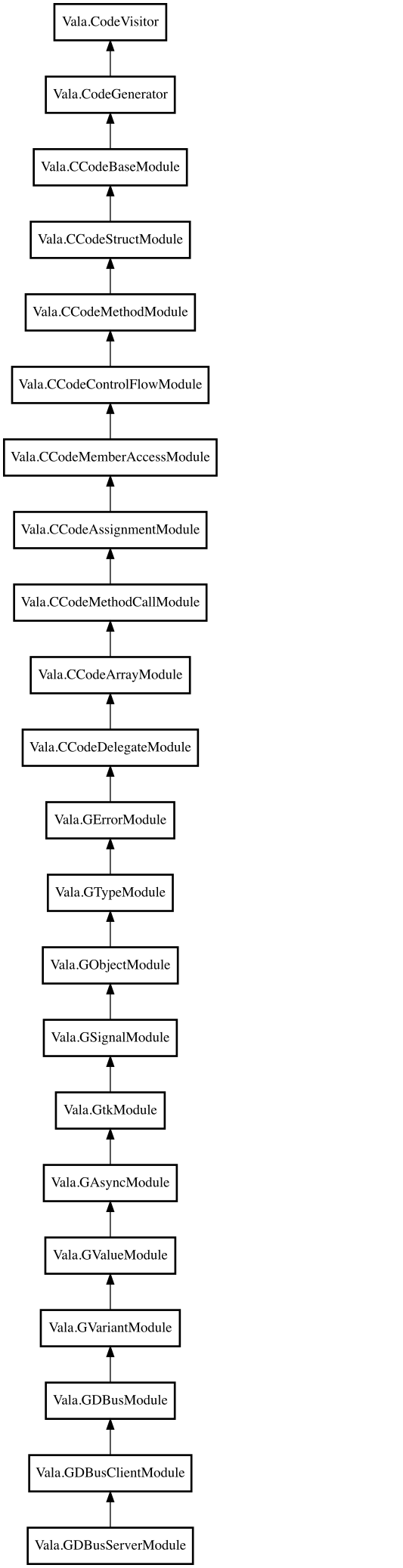
Inheritance is used to stack code generation functionality between subclasses, expanding on the method overrides of parent classes. are modules that provide functionality for the code generation process.
Vala.CCodeBaseModule is a module that provides base functionality for the code generation process. For additional functionality, Vala.CCodeStructModule (codegen/valaccodestructmodule.vala) extends the Vala.CCodeBaseModule class, however the module specifically handles how C structs should be generated from Vala code. We keep stacking functionality using modules in the inheritance tree until we've reached the desired amount of functionality. That's where the instance types based on the profiles come in. They've implemented an appropriate amount of functionality to be able to generate code for those profiles.
Note
All of the code generation modules (e.g. CCodeArrayModule, CCodeAssignmentModule, GAsyncModule, GObjectModule, and others) live in the codegen directory, following the vala<class-name-lowercase>.vala naming convention.
However, as more features are added to the language, the inhertiance trees for the code generation classes Vala.CodeGenerator classes may grow further. Or a slightly different inheritance tree may be created for new profile, with modules that are specific for that new profile.
Here's the object hiearchy graph for the Vala.GDBusServerModule class:
3.6.2. Attributes
C code generation is the largest single consumer of attributes in the compiler, specifically of CCode - see 3.2.5. Attributes for how attributes are parsed and stored in general.
Wherever a code generation module needs to know how a Vala symbol maps onto C - its C identifier, header filename, type id, ref and unref functions and so on - it calls one of the Vala.get_ccode_*() functions in codegen/valaccode.vala, such as Vala.get_ccode_name (), Vala.get_ccode_const_name (), Vala.get_ccode_type_name () and Vala.get_ccode_header_filenames (). There are around seventy of these public wrapper functions in total.
Each one is backed by Vala.CCodeAttribute (codegen/valaccodeattribute.vala), which wraps a single code node and exposes the C-level information the generator needs as properties - name, const_name, type_name, header_filenames, prefix, ref_function and many more. Every property lazily reads the corresponding CCode argument from the node's raw Vala.Attribute, and, when that argument wasn't given in the source, computes a sensible default from the Vala symbol instead. So [CCode (cname = "...")] overrides a C name that would otherwise be derived automatically from the Vala declaration's name.
Vala.CodeNode supports caching this generically: a node carries an attributes_cache array of Vala.AttributeCache slots, accessed with get_attribute_cache () and set_attribute_cache (), and each kind of cache claims a unique slot index from the static Vala.CodeNode.get_attribute_cache_index (). Vala.CCodeAttribute extends Vala.AttributeCache, so exactly one instance is created per code node - the first time any get_ccode_* function is called on it - and every later call reuses it rather than re-reading and re-deriving attribute strings.